
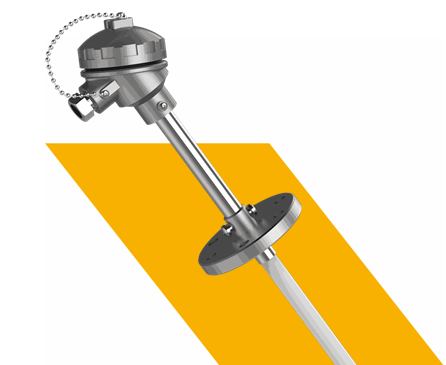
Pick the wrong temperature sensor and you'll find out the hard way, usually during a shutdown, a failed batch, or a calibration audit that goes sideways. Thermocouples and RTDs both measure temperature, but they do it through completely different physics, and that difference shapes everything from response speed to accuracy to how long the sensor lasts on your line.
How a Thermocouple Works
A thermocouple is built from two dissimilar metal wires joined at one end. That joint, called the hot junction, sits at the measurement point. The other end, the cold junction, connects back to the measuring instrument. When there's a temperature difference between the two junctions, a small voltage is generated. This is the Seebeck effect, and it's been the backbone of industrial temperature measurement for well over a century.
Because the sensing element is just two wires twisted or welded together, thermocouples are small, tough, and quick to react to temperature swings. There's no fragile ceramic core to worry about, and no current needs to pass through them to get a reading. That simplicity is exactly why they show up in furnaces, kilns, exhaust stacks, and anywhere else conditions get punishing.
Common Thermocouple Types and Where They Fit
K and N type thermocouples are the workhorses of oxidizing environments. Steel plants and furnace operators lean on them constantly because they hold up well when oxygen is present. T type thermocouples go the other direction, built for cryogenic work where temperatures drop well below freezing. J and E types cover specific niche conditions depending on the industry and the exact process chemistry involved.
At the extreme end, refractory thermocouples made from tungsten and rhenium handle temperatures up to roughly 2320°C. These aren't sensors you'd use casually. They're reserved for vacuum furnaces and non-oxidizing environments where almost nothing else survives. Type S, R, and B thermocouples, built with platinum or platinum-alloy elements, cover the range up to around 1600°C and are common in glass manufacturing, ceramics, and high-temperature metallurgy.
Base metal thermocouples, made from nickel, iron, and copper alloys, remain the most widely used option across general industry. They're cost-effective, mechanically resilient, and they hold up against vibration and cyclic thermal loading, which matters a lot on a rolling mill or a continuous process line.
How an RTD Works: Why It's Different
An RTD, or resistance temperature detector, measures temperature using a very different mechanism. It doesn't produce a voltage , but takes advantage of the predictable change in electrical resistance of a metal with temperature . Pass a small current through the element, measure the resistance, and translate that number into a temperature reading.
Platinum is the metal of choice here, and for good reason. It has a very linear resistance-temperature relationship, resists chemical attack and is stable over long periods of use. Under DIN/IEC 60751, the industry standard, a Pt100 element is required to read exactly 100.00 ohms at 0°C and possess a temperature coefficient of 0.00385 ohm per ohm per degree Celsius between 0°C and 100°C. There are also Pt500 and Pt1000 versions that have more resistance per degree and so more resolution in some wiring configurations .
RTDs typically operate from around -200°C up to 850°C. That's a narrower ceiling than what thermocouples can reach, but within that band, RTDs deliver better accuracy and far better repeatability over time.
Thin Film vs Coiled Elements
RTD construction generally falls into two camps. Thin film elements are made by depositing a microscopically thin layer of platinum onto a ceramic chip, then laser-cutting a resistance path into it. They're rugged, inexpensive to produce, and widely used, though they're slightly less stable than their coiled counterparts. Coiled RTDs use ultra-fine platinum wire wound and housed inside ceramic insulators. They cost more, but they hold their calibration longer, which matters in labs and critical process applications where drift simply isn't acceptable.
Accuracy, Response Time, and Durability
RTDs win on accuracy and long-term stability, no contest. A well-installed Pt100 in a 3-wire or 4-wire configuration will hold its calibration far longer than a thermocouple, and it won't drift the way base metal junctions can after repeated thermal cycling.
Thermocouples win on speed and toughness. Because there's less mass at the sensing junction, they respond to temperature changes faster. They also tolerate mechanical shock, vibration, and extreme temperatures that would damage an RTD's more delicate element. A rolling mill or a furnace with rapid temperature swings is thermocouple territory. A pharmaceutical lab or a calibration bench, where fractions of a degree matter, is RTD territory.
Cost plays a role too. Thermocouples, especially base metal types, are generally cheaper upfront. RTDs cost more to manufacture and calibrate, but that expense often pays for itself through reduced recalibration cycles and tighter process control.
Matching the Sensor to the Application
Start with your temperature range. If you're working above 1200°C, you're likely looking at a noble metal or refractory thermocouple since RTDs simply don't operate reliably that high. If your process sits comfortably under 850°C and demands tight accuracy, an RTD is probably the better call.
Next, think about the environment. Vibration, mechanical shock, and rapid thermal cycling favor thermocouples. Stable, controlled conditions where precision is non-negotiable favor RTDs. Also consider wiring distance. Pt1000 RTDs handle long cable runs better than Pt100 because the higher base resistance reduces the impact of lead wire resistance, something worth checking before you finalize a design.
For hazardous or explosive atmospheres, both sensor types are available with certifications such as ATEX, IECEx, and CE, so that alone shouldn't be the deciding factor. What should be the deciding factor is how the sensor will actually be installed. A thermowell-protected assembly, for instance, lets you swap or recalibrate the sensor without shutting down the process, which is worth factoring into either choice.
Conclusion
A thermocouple's ruggedness and wide temperature range make it the right pick for furnaces, kilns, and heavy industrial processes with rapid thermal swings. An RTD's precision and stability make it the right pick for labs, pharmaceutical processes, and any application where drift over months or years simply isn't tolerable.
The smartest approach is to define your actual operating conditions first: temperature ceiling, required accuracy, vibration exposure, cable run length, and atmosphere. Once those variables are clear, the choice between a thermocouple and an RTD tends to make itself.





Leave a Comment