
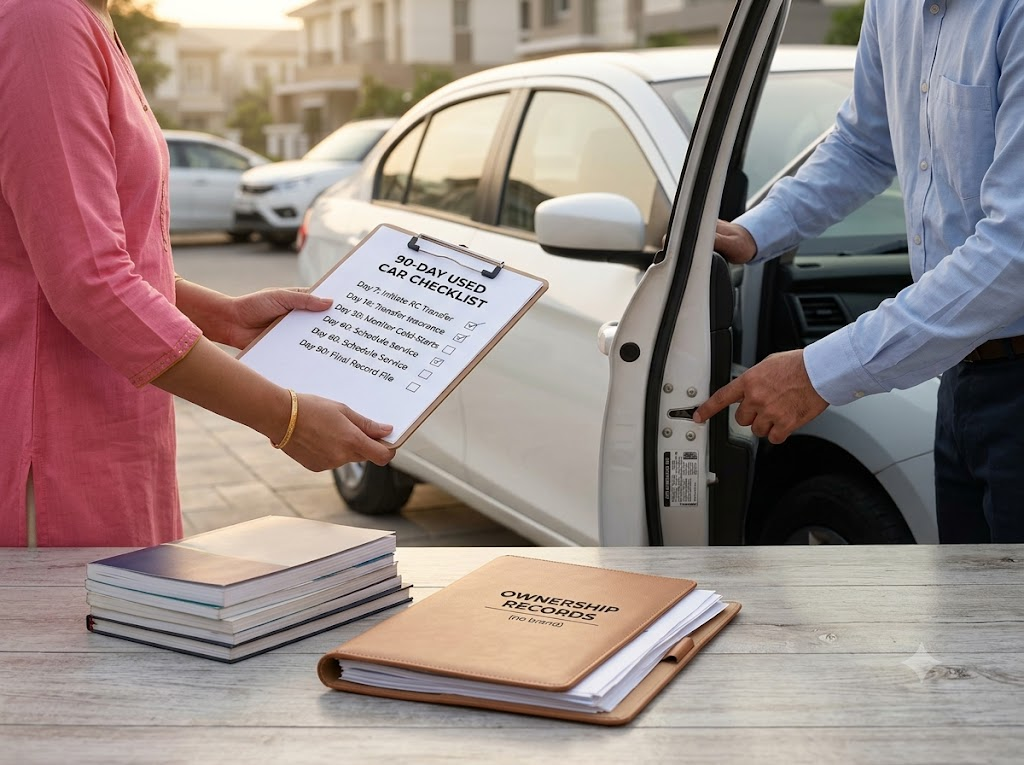
The first 90 days after buying a used car are the most important for confirming that everything works as expected and that all ownership formalities are completed. A practical post-delivery checklist includes verifying your documents, transferring insurance and RC, monitoring the car for warning signs, scheduling preventive maintenance, understanding your warranty, and keeping service records organised. Following these steps helps you catch small issues early, avoid unexpected expenses, and start your ownership experience with confidence. This guide walks you through exactly what to do during the first 90 days after taking delivery of a used car in India, with a clear timeline and actionable recommendations.
Why the first 90 days are decisive
The first 90 days determine whether ownership paperwork, warranty protection, insurance coverage, and the vehicle's mechanical condition are fully established. Buying a used car does not end at delivery. The purchase is only truly complete once the RC transfer, insurance transfer, warranty registration, and initial ownership checks have been completed. Until then, the purchase is conditional, even if the keys are now with you.
The legal and policy clocks often run together. Return windows are capped by days and kms, and warranty registration usually needs to be done within a specific period. Even Insurance transfer should happen within 14 days of sale; otherwise, own-damage claims can be denied. This is why the period immediately after bringing home a used car is often the most crucial in the car’s entire ownership journey.
Days 1 to 7: Lock the paperwork basics
During the first 7 days after buying a used car, your priority should be completing the ownership paperwork, transferring insurance, confirming the RC transfer process, activating any warranty, and securely storing all purchase documents. These tasks help establish legal ownership, preserve warranty and insurance benefits, and reduce the risk of administrative or claim-related issues later. Thus, as soon as you bring the used car you love home, make sure to:
- Confirm RC transfer is initiated: You should see an acknowledgement from the platform, dealer, or owner that the application has been submitted. Note the application number.
- Transfer the insurance: Without insurance in your name, only third-party cover applies for the first 14 days post-sale. Own-damage claims can be denied. Get the endorsement done within the first week.
- Collect the inspection report and final-price slip: Both documents matter if a dispute arises later.
- Check for pending challans: Use the VAHAN portal or your state RTO's e-challan page to confirm there are no open fines against the chassis number.
- Register your warranty: If the warranty needs activation (most do), complete that paperwork in the first week.
- Save support contact details: Note the platform's or dealer's ticket-raising channel, email address, and escalation path. Save them before you need them.
Completing these steps is much easier when you buy from an organised used car platform instead of handling everything independently. Since RC transfer can involve paperwork with multiple authorities, organised platforms like Cars24 simplify this through end-to-end RC transfer assistance. Before a car is even listed on the platform, it also undergoes a comprehensive 300-point inspection that includes verification of ownership records, legal and financial history, and other critical checks. Combined with year-round customer support and reliable post-purchase protection (30-day repair assurance and 30-day returns) and warranty plans (12-month standard warranty) bundled with the purchase of every inventory-owned used car, buyers focus less on administrative follow-ups and more on enjoying their new car during the first week of ownership.
Documents You Should Receive on Delivery
- RC copy
- Sale invoice
- Form 29/30 acknowledgement (where applicable)
- Insurance papers
- Inspection report
- Warranty booklet
- Service history
- Spare key
- Owner's manual
Organised platforms generally provide these documents as part of the delivery process, making it easier to complete RC transfer, register warranties, and maintain a complete ownership record.
Days 7 to 30: The return and defect window
Between Day 7 and Day 30, your focus should shift from paperwork to confirming that the used car performs as expected in everyday driving. This is the period to identify any mechanical, electrical, or drivability issues, understand your return and warranty terms, and report concerns within the applicable timelines. Acting promptly during this window ensures that eligible repairs, replacements, or returns can be processed without unnecessary delays.
Use this window to:
- Drive the car in your normal daily mix (city traffic, parking, occasional highway).
- Watch for cold-start issues, gear-engagement problems, electrical glitches, and AC performance.
- Note any rattles, brake squeaks, or steering pull, and report them in writing while you are still in the warranty/return window.
- Get an independent mechanic walkaround at the 1,000 km mark to catch anything the inspection missed.
This is where buying from an organised platform can make a meaningful difference. Cars24, for example, complements its pre-delivery inspection process with a 30-Day (up to 999 km) Return Policy on eligible cars, giving buyers time to evaluate the vehicle in real-world driving conditions. In addition, the platform’s 30-day (up to 1,500 km) repair assurance provides repair assurance for eligible issues during the initial ownership period, while year-round customer support ensures buyers have assistance whenever questions or concerns arise. Together, these measures help make the first month of ownership more predictable and reassuring.
Days 30 to 60: The first independent service check
By day 30, you have enough driving impressions to know if anything feels off. Day 30 to 60 is the right window to do your first independent service check, even if the car was recently serviced before sale.
Cover the basics and make sure to check:
- Wheel alignment
- Wheel balancing
- ECU scan
- Suspension bush inspection
- Brake fluid
- Coolant
- Air filter
- Cabin filter
- Battery health
- Tyre rotation
Days 60 to 90: Lock the service rhythm and escalation path
By day 60, your RC should be in your name. If it is not, escalate. By day 90, the car should have a defined service schedule (every 6 months or 6,000 km is a useful default) and a documented support contact for warranty claims.
Take 30 minutes to do the following:
- Update the registered owner on insurance and warranty records if RC transfer is completed
- File the inspection report, final-price slip, RC, insurance, warranty card, and service receipts in one folder (physical or digital)
- Save the escalation chain in writing: ticket → CX email → consumer-grievance officer → consumer forum (if needed)
- Plan the next service date and put it on your calendar.
The 90-day quick-reference checklist
| 7 | RC transfer initiated, application number noted | Until RC is in your name, challan and accident liability stay with the previous owner |
| 7 | Insurance transferred to your name | Own-damage claims may be denied without endorsement |
| 7 | Inspection report and final-price slip filed | Baseline for any dispute or warranty claim |
| 7 | Warranty registered | Some plans require activation within a specific period |
| 30 | Drive in your normal mix; raise defects in writing | Return window and complimentary warranty are time and km-capped |
| 60 | First independent service check | Catches issues the seller-side inspection missed |
| 60 | RC transfer should be initiated for intra-state sales | Section 50 of the Motor Vehicles Act sets a 14-day initiation timeline for intra-state transactions |
| 90 | Service rhythm locked, escalation path saved | Reduces friction the first time you need warranty support |
What if something goes wrong?
Most used car ownership experiences are smooth, but knowing how to respond if an issue arises is just as important as preventing one. Whether it's a mechanical concern, a paperwork delay, or a warranty-related query, acting quickly and following the correct support process can significantly improve the chances of a timely resolution.
If you experience a problem with your used car after delivery, report it immediately through the seller's official support channels and keep a written record of every interaction. Most warranty, return, and repair policies have defined timelines, so raising the issue promptly improves the chances of a quicker resolution. Save emails, support ticket numbers, inspection reports, invoices, and photographs, as these documents can be valuable if the matter needs to be escalated.
Gearing Up for a Long-Term Ownership
Buying a used car is only half the journey. The first 90 days determine whether your ownership experience remains hassle-free for years or turns into repeated paperwork, repairs, and avoidable expenses. Buyers who follow a structured post-delivery checklist are also better prepared to handle warranty claims, preserve resale value, and keep accurate ownership records.
Choosing an organised used car platform makes these first 90 days significantly easier. With end-to-end RC and insurance transfer assistance, a comprehensive 300-point pre-listing inspection, transparent ownership, legal and financial verification, post-purchase protection such as a 30-Day Return Policy and 30-Day Repair Assurance, standard warranty coverage, and year-round customer support, Cars24 helps simplify every stage of ownership beyond the day of delivery. Whether you're buying your first used car or upgrading to another vehicle, a well-supported ownership experience begins with the right platform and a clear 90-day plan.
FAQs
How long should RC transfer take in India?
Under Section 50 of the Motor Vehicles Act 1988, the process of RC transfer should be initiated within 14 days intra-state or 45 days inter-state. However, real-world timelines vary by RTO and other intervening factors.
Can I drive the car before insurance is in my name?
Legally, third-party cover applies for the first 14 days post-sale, so basic legality is preserved. But your own-damage claim can be denied without the transfer. Complete the endorsement in the first week.
What if I notice a defect on day 25?
Raise it in writing within the warranty or return window. If the return window applies and you are within day and km limits, you have the option to return with deductions. If the warranty applies, the platform should diagnose and repair at no out-of-pocket cost (engine, transmission, drivetrain coverage typically).
How do I know if my warranty is engine-only or full bumper-to-bumper?
Read the warranty document, not the marketing line. Most used-car warranties in India cover engine, transmission, and drivetrain only, with wear-and-tear, accidents, flood, and commercial use excluded.
Should I do a paid PDI even after a platform inspection?
An independent walkaround in the first 30 days is cheap insurance. It catches anything an inspection might miss and gives you written backup if you later need to raise a warranty claim.





Leave a Comment