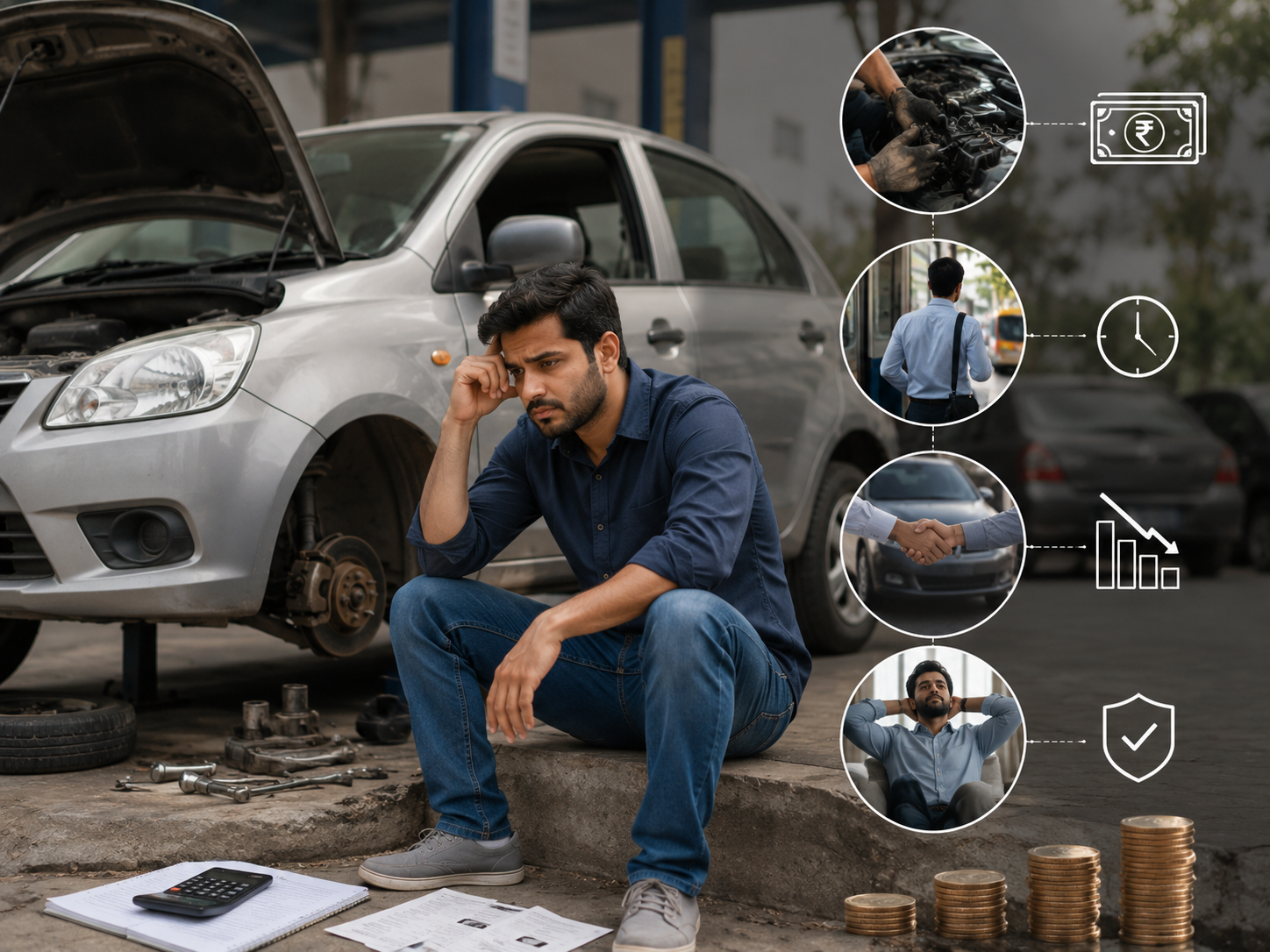
When a buyer chooses the lowest-priced used car they can find, they are making a decision that looks financially sensible at the point of purchase. A car that saves two lakh rupees at purchase appears to leave two lakh rupees more in the bank. But this calculation only works if the cost of ownership over the following 12 to 24 months is the same for both options, which usually isn’t the case.
The cars that are priced significantly below the market rate are often priced that way because something has been deferred. Tyres that are at or below the safe tread depth. A battery that starts the car reliably, but is one cold morning from failing. Suspension components that have developed play. An air conditioning system that cools, but not as efficiently as it should. Brake pads that will need replacement within the next five thousand kilometres.
None of these items shows up prominently in a twenty-minute test drive. All of them show up in the first three months of ownership, in the form of unexpected bills at the workshop.
What a Full-Cost Calculation Actually Looks Like
A useful way to compare used car options is to estimate the total cost of the car over 24 months, not just the purchase price. The total cost includes the purchase price, RC transfer costs, immediate expenses on the car before it is truly road-ready, expected service costs at appropriate intervals, any repairs that the pre-purchase inspection identified as needed, insurance premiums, and the estimated resale value at the end of the period.
| Factor | Cheap Unverified Car | Inspection-Backed Certified Car |
| Purchase Price | Lower | Slightly higher |
| Immediate Repairs | Uncertain | Documented |
| Warranty | Rare | Available |
| Downtime Risk | Higher | Lower |
| Resale Confidence | Lower | Higher |
| Ownership Predictability | Poor | Better |
A used car that costs three lakh rupees to purchase but needs forty thousand rupees of tyres immediately, thirty thousand rupees for a battery and service, and develops a suspension issue at six months that costs twenty-five thousand rupees to fix has a 24-month ownership cost that is significantly different from its purchase price.
A car that costs three lakh eighty thousand rupees but comes with a thorough inspection, passes all checks at the time of purchase, and carries a warranty on its major components is a different financial proposition. The question is not which car costs less to buy, but which car costs less to own.
Tyres, Battery, and Consumables: The Immediate Expense Category
Three categories of used car expenses tend to surprise new owners more than any others. These are tyres, a battery, and the immediate service that the car needs when it enters a new owner’s hands.
Tyres are safety-critical and cannot be deferred once they fall below safe tread depth. A used car with four tyres that each need replacement within the first year carries a hidden expense of anywhere between six and forty thousand rupees, depending on the tyre size and brand, before any other ownership cost is considered.
The battery question is particularly difficult because a weak battery can start a car reliably on warm days and fail without warning on a cold morning or after the car has sat unused for a few days. Battery health testing requires a load test, not just checking whether the car starts. A battery that is approaching the end of its life represents a near-term expense that should be factored into the purchase price.
The first service under new ownership is typically more expensive than subsequent services because a new owner often discovers that the previous owner deferred oil changes, filter replacements, or other maintenance items that were due. A car that has been properly maintained costs less at the first service. A car that has been neglected requires catching up.
How Inspection-Backed Cars Reduce Surprise Expenses
Cars24’s 300-point inspection process covers tyres, battery health, brake pad condition, and fluid quality, alongside the structural and mechanical assessment. Every identified deficiency is documented in the inspection report before the car goes on sale. This means a buyer can review the condition of every consumable before making a purchase decision.
Every used car listed on Cars24 with a documented note that the rear tyres have adequate but not generous tread remaining is a car where the buyer knows that tyre replacement is a near-term cost and can factor it into their decision. That is fundamentally different from buying a car where the tyre condition was never independently measured, and the seller described them as fine.
When a used car passes the full inspection without significant shortcomings, the buyer has documented evidence that the car does not carry hidden immediate expenses. When findings exist, they are disclosed. Either way, the buyer makes an informed decision rather than discovering costs after the transaction is complete.
The standard as well as extended warranty layer further adds another dimension to cost protection. A car covered under the Cars24 Lifetime Warranty Plan carries no out-of-pocket cost for covered engine, transmission, or drivetrain failures for an extended period of up to 12 years or 1,50,000 km. For a buyer who is concerned about the financial exposure of unexpected major repairs, this coverage directly addresses that concern.
Resale Value and Why It Matters Even for People Who Think They Will Keep the Car
Most buyers say they plan to keep a car for five to eight years when they buy it. Many end up selling it in three. Life circumstances change: families grow, jobs move to different cities, income increases to the point where upgrading makes sense, or a car simply does not perform as expected, and the buyer wants to move on.
The resale value of a car is influenced by its condition, its documentation history, and whether it carries any known issues that make the next buyer uncomfortable. A car with a complete service history and clean documentation sells faster and at a better price than a car with gaps in either.
A car that was poorly maintained and developed problems during ownership often shows evidence of those problems in the form of non-standard repairs, changed components, or wear that is inconsistent with the mileage. These signs reduce the confidence of the next buyer and therefore reduce the price they are willing to pay.
Buying a car that was well-inspected, properly documented, and properly maintained during ownership protects resale value at the back end of the ownership period. The cost difference between a well-maintained car and a neglected one, measured over three to five years of ownership, including resale, is almost always larger than the initial purchase price difference that made the cheaper option seem attractive.
When Paying a Little More for Protection Actually Makes Financial Sense
The idea that a cheap car saves money is correct only if nothing goes wrong. Paying a few thousand rupees more for a car that has been through a rigorous inspection, comes with documented condition, carries a warranty on its major systems, and includes a return window is not the same as overpaying. It is buying a different product. The difference is not cosmetic. It is the difference between an unknown car and a verified car.
For buyers who are working with tight budgets, the car that fits the budget and has been properly inspected will almost always be a better financial outcome than the car that comes in just under budget with no meaningful assessment of what the budget is actually buying.