Sedans in India have been declared dead so many times that the repeat announcements have started to feel performative. It’s true that SUVs dominate the conversation, the sales charts, and the advertising budgets. But the sedan hasn’t disappeared, it has simply narrowed to a pool of buyers who know precisely what they want and aren’t easily talked out of it. The Skoda Slavia is a car built for exactly that audience.
Launched in 2022, the Slavia replaced the ageing Rapid as Skoda’s mid-size sedan in India. It’s built on the MQB-A0-IN platform, the same Volkswagen Group architecture localised specifically for India that underpins the Kushaq, Taigun, and Virtus, and the shared underpinnings bring real benefits without making the cars feel identical.
Two engine options define the Slavia’s character. The 1.0-litre TSI three-cylinder turbocharged petrol, producing 115 horsepower and 178 Nm, is available with a 6-speed manual or a 6-speed automatic, and it covers the everyday use case with surprising efficiency. Real-world fuel economy regularly sits in the 14-17 km/l range for mixed driving, which for a mid-size sedan is genuinely competitive. It’s also a smooth engine that idles quietly and doesn’t call attention to itself, which suits the Slavia’s character well.
The 1.5-litre TSI, making 150 horsepower and 250 Nm, is the version that earns more enthusiastic coverage, and for good reason. Paired with the 7-speed DSG dual-clutch transmission, it transforms the Slavia from a well-made commuter into something that can cover ground with real urgency when asked. The DSG responds to paddle shift inputs quickly and predictably, and the additional torque means overtaking manoeuvres on two-lane highways feel measured and safe rather than tentative.
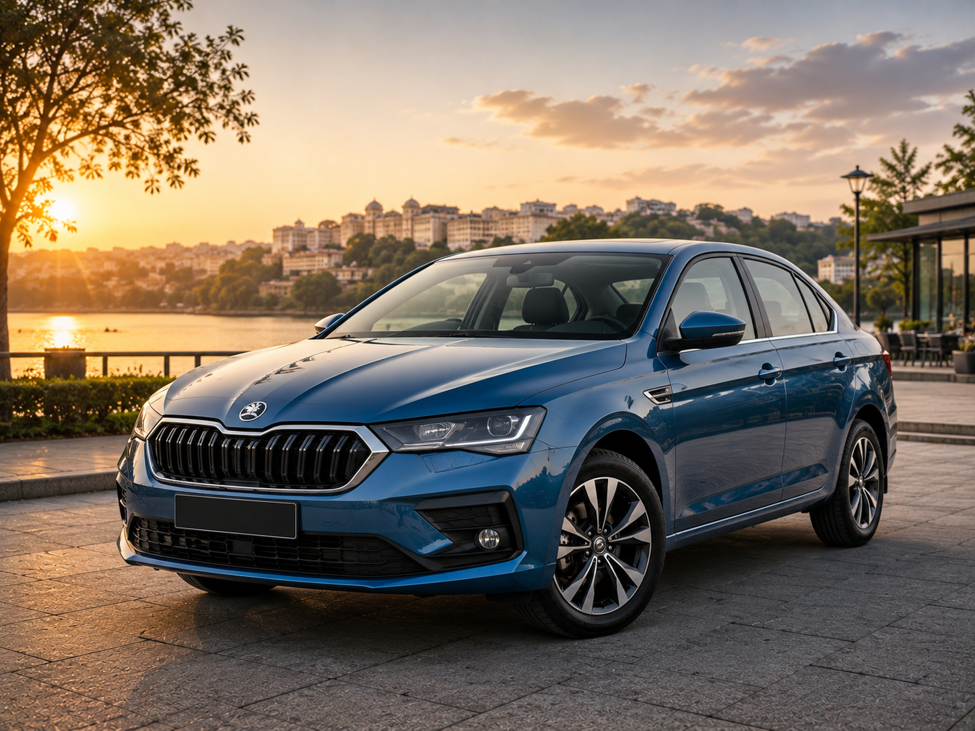
Skoda made a smart design choice with the Slavia’s exterior. It’s low-slung, with a long bonnet and a wide stance that reads as properly European without being ostentatious. The chrome treatment is restrained. Wheel arch proportions are well-resolved. It’s a car that looks better the longer you spend with it, quietly confident rather than loudly styled.
Inside, Skoda’s cabin philosophy is on full display. There’s a 10-inch touchscreen, a digital instrument cluster, wireless Android Auto and Apple CarPlay, ambient lighting, and a ventilated driver’s seat in top trim. The attention to tactile quality, the resistance of the climate control dials, and the thud of the door closing are the kind of thing that Skoda gets right consistently, and it’s one of the primary reasons buyers who experience these cars tend to stay with the brand.
Boot space is a genuine talking point: at 521 litres, the Slavia has one of the more cavernous boots in the mid-size sedan segment. For families that actually use their car for trips, not just daily commuting, that’s a meaningful number.
The Skoda Slavia starts around ₹11.5 lakh and reaches approximately ₹19 lakh in the fully specced 1.5 TSI DSG Monte Carlo trim. Those prices are honest for what you receive. The broader Skoda cars range in India also includes the Kushaq SUV and the Kodiaq at the premium end, which means the Slavia now sits within a coherent lineup rather than as an isolated product, making brand loyalty a reasonable outcome for satisfied owners.
The Monte Carlo variant at the top of the range deserves a mention. It brings a sportier visual treatment, black roof, 17-inch alloys, red brake callipers, and black interior accents, that makes the Slavia look athletic without being juvenile. For buyers who want restrained design with personality, it’s the most complete expression of the car.
Road manners are a Slavia strength. The suspension balances composure in corners with sufficient compliance on broken surfaces, a calibration that European-tuned competitors sometimes miss on Indian roads. The steering has good weight and a direct feel, and the 1.5 TSI especially rewards a driver willing to engage with it rather than just pointing it somewhere.
The criticism levelled at the Slavia and Skoda cars generally concerns service network density and after-sales costs. The brand has expanded its touchpoints significantly over the last two years, and the 4-year standard warranty (extendable to 6 years) considerably softens after-sales concerns. It’s a fair concern to raise, but less decisive than it once was.
For buyers who understand that driving dynamics, build quality, and interior refinement are worth something, and who aren’t chasing the SUV segment purely because advertising said so, the Slavia makes one of the more compelling arguments for the sedan body style in the Indian market right now. It’s a car that rewards attention. And in a market that often doesn’t, that matters more than people admit.