Options trading is associated with strategies, market views, and timing. But along with these elements having the right tools can significantly improve decision-making. Markets can move quickly, and relying solely on intuition or price charts makes it riskier.
The professional traders use tools that help them understand market sentiment, volatility, risk, and positioning before entering a trade. Tools do not guarantee profits, but they provide valuable information that can help you make better trading decisions. The right tools can help traders better gauge opportunities, whether the market is trending strongly, moving sideways, or becoming more volatile.
Option chain
One of the most popular tools in option trading is the option chain. It shows you the available call and put contracts at various strike prices with useful information like open interest, volume and implied volatility.
Volume displays the total traded volume, and implied volatility displays the expected volatility in the near future. The open interest shows where traders are building positions. A noticeable build-up in call open interest may indicate a potential resistance level, while large put open interest can suggest support.
Implied volatility
Many beginners focus only on price direction, but experienced options traders pay close attention to implied volatility (IV).
Implied volatility reflects the market’s expectation of future price movement. Higher IV generally leads to higher option premiums because the market expects larger price swings. Lower IV usually results in cheaper premiums due to expectations of relatively stable prices.
Greeks
Options Greeks help traders understand how an option’s value may change under different market conditions.
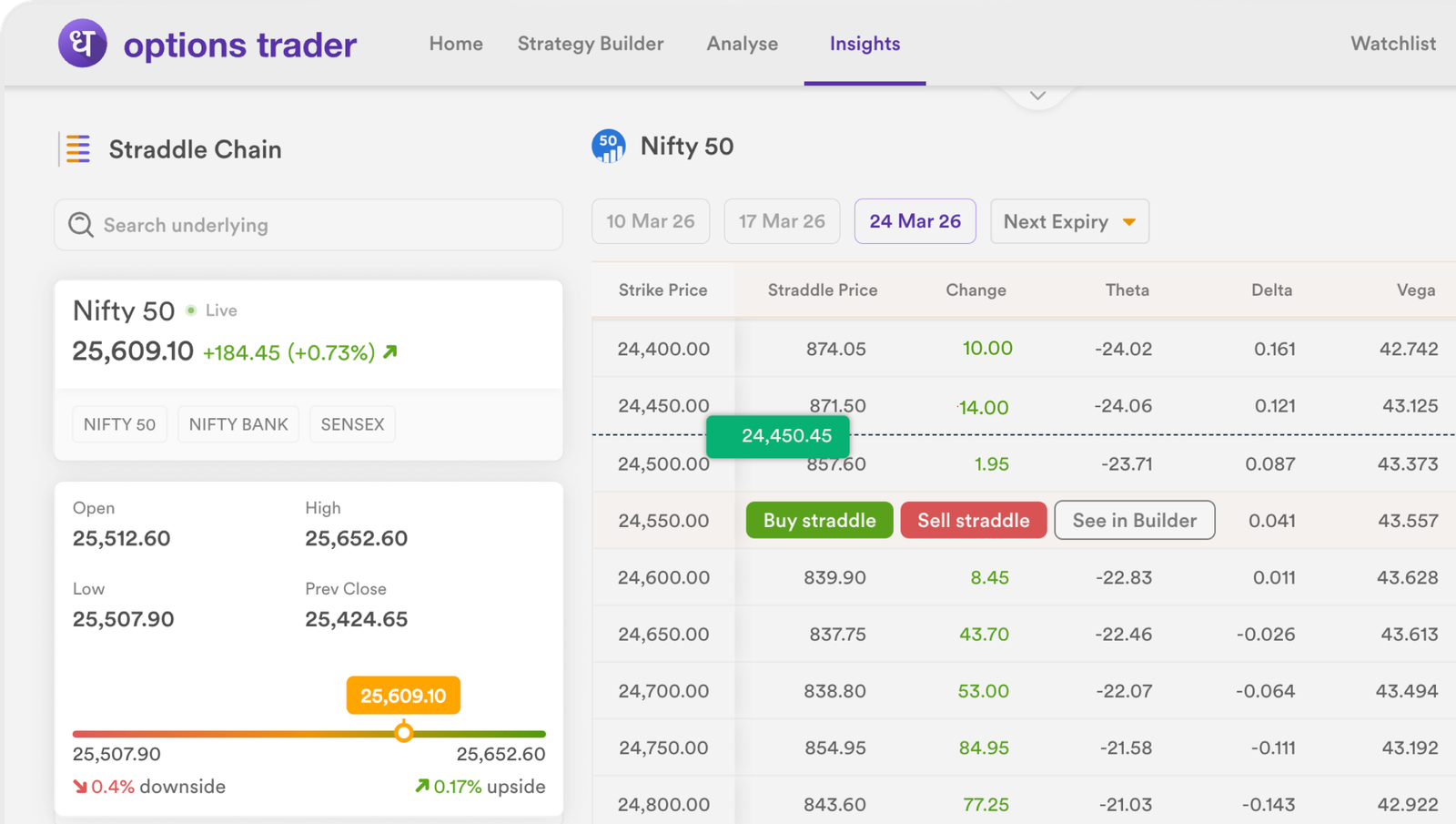
Delta measures how much an option price may move relative to the underlying asset. Theta estimates the impact of time decay, while Vega shows how sensitive an option is to changes in volatility.
Suppose a trader holding a long option position is close to expiry. Even if the underlying asset remains stable, the option’s value may decline due to Theta. To understand this decline without any price move, the traders need to understand the effect of theta.
By understanding the Greeks, a trader can evaluate the trader from multiple angles, instead of focusing only on the direction.
Volatility and market sentiment indicators
Indicators like the Put-Call Ratio (PCR) help traders gauge market sentiment. If the PCR is greater than 1, then the market is in bearish sentiment. If the PCR is less than 1, it signals a bullish sentiment.
PCR should not be used alone; it can be useful with Price Action and Open Interest data for context.
Indices that measure volatility may reflect rising fear or uncertainty in the broader market. Rising volatility often impacts option pricing and can affect strategy selection.
Strategy builders and payoff calculators
There are many option strategies that involve multiple legs, and it is difficult to estimate potential by thinking alone. Traders can visualise profit and loss scenarios before executing a trade with the help of strategy builders and payoff calculators.
With these tools, you can see and analyse how a particular strategy may perform across different price levels and market conditions.
For example, if you want to use a straddle strategy as per your analysis. By using the strategy builder, you can directly see the straddle chart on the screen with all the details like maximum profit, maximum loss, and breakeven points. This helps ensure the strategy aligns with their expectations and risk tolerance. You can access strategy builders on a modern options trading platform.
Conclusion
Options trading involves more than just predicting market moves. Traders consider volatility, risk, market position and possible outcomes when trading options before entering a trade. They get an additional advantage while trading with the help of tools like strategy builders, Greeks, option chains, etc.
No tool can dispel uncertainty, yet utilising different tools and data can provide an enhanced structure and discipline to the trader.