
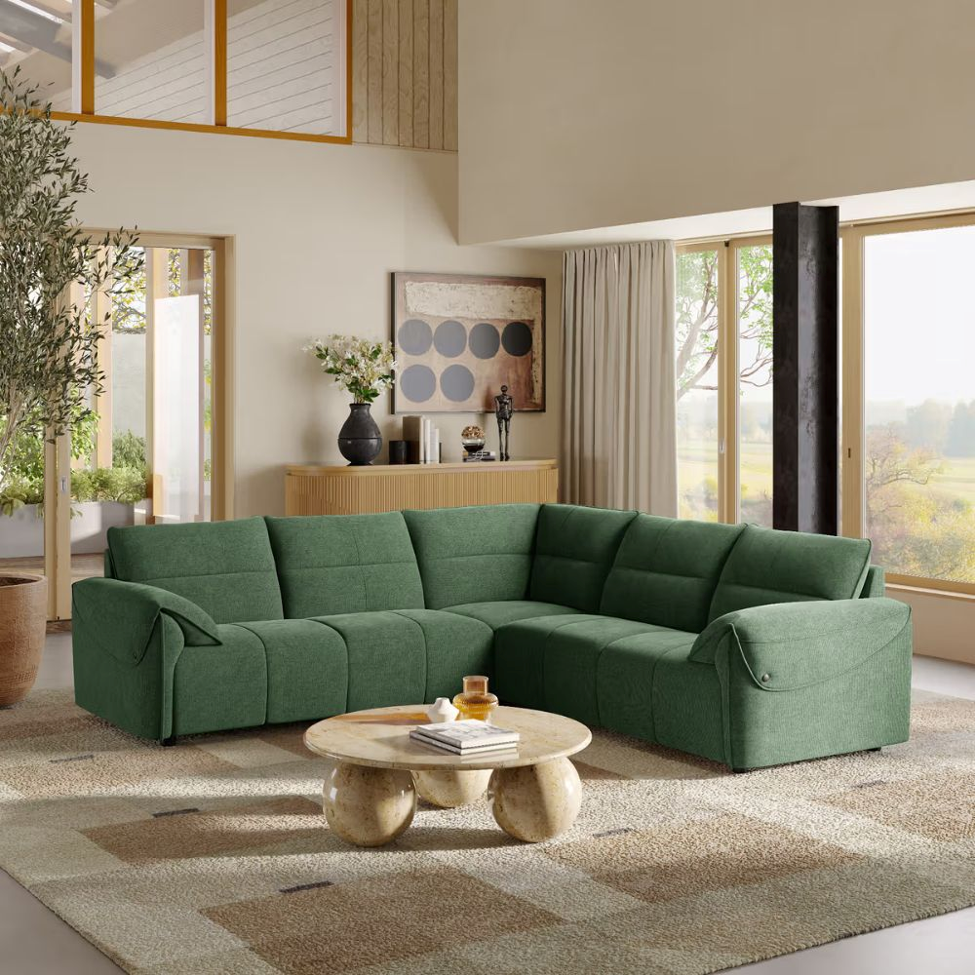
When a sofa starts to fail, it fails in one place: the right seat. Not the left seat, not the armrests, not the back cushion - the right seat, because that is where the main occupant sits every evening. The valley develops slowly, over 18 to 24 months, until it is the first thing you feel when you sit down. By then, the sofa is three years old, the frame is in perfect condition, and you are looking at a replacement. The frame will outlast the foam by fifteen years. Nobody talks about the foam. Every sofa comparison you will find in India - at any sofa set price - talks about the wood frame. This guide is about the part that actually fails.
Why does every sofa comparison focus on the wood frame when the wood is not what fails?
Because wood is visible and foam is not. You can see the grain of sheesham. You can knock on the arm and hear whether it is solid or hollow. You can make a judgement call on the frame in thirty seconds in a showroom. The foam inside the seat cushion is inaccessible until the upholstery is cut open, and it looks identical at 25 kg/m3 and at 45 kg/m3. You cannot assess it by looking. You cannot assess it by sitting on a new cushion for ten minutes. It only reveals itself after a year of regular use, at the exact point where returning the sofa is no longer an option.
The result is that most Indian buyers optimise for the wrong variable. A sheesham-framed sofa at Rs 35,000 with 30 kg/m3 foam will outlast a particle board-framed sofa in the frame - and fail completely in the seat within three years. A solid wood sofa with 42 kg/m3 foam will give you a decade of comfortable sitting before the frame ever becomes relevant. The frame is the part that looks good in photographs. The foam density is the part that determines whether the sofa is worth the price five years later.
What does the sofa set price bracket actually buy in construction terms?
| Sofa Set Price Range | Frame Material | Foam Density (Typical) | Expected Seat Lifespan | Best Suited For |
| Rs 15,000-25,000 | Engineered wood or metal base | 28-32 kg/m3 | 2-3 years | Occasional rooms, rental use |
| Rs 25,000-40,000 | Solid wood or seasoned hardwood | 32-38 kg/m3 | 4-6 years | Regular family use |
| Rs 40,000-65,000 | Solid sheesham or teak | 38-45 kg/m3 | 7-10 years | Primary living room, daily use |
| Rs 65,000+ | Premium solid wood with corner bracing | 45 kg/m3+ | 10-15 years | Long-term investment, heavy daily use |
The most expensive mistake is buying at Rs 30,000 to 40,000 with a ten-year expectation. At this price, the frame is usually solid and correctly jointed. The foam is almost always where cost was compressed. A buyer who paid Rs 36,000 for a sofa that feels perfect on day one and develops a right-seat valley by year three did not buy a bad sofa - they bought a sofa whose foam density was not disclosed, and they had no way to check.
How do you check foam quality on a sofa you cannot open?
Two checks work without any tools.
The recovery check: sit at the centre of the main seat with your full weight for five minutes. Stand up and watch the cushion. If it returns to its original shape within 30 to 60 seconds, the foam density is adequate for regular daily use. If it holds an impression for longer than 60 seconds and recovers slowly, the density is below the threshold for long-term use. Memory foam sofas are the exception - slow recovery is intentional with that material. For standard fabric and leatherette sofas, fast recovery is the indicator you are looking for.
The corner press: press your thumb firmly into the back corner of the seat cushion - the area that gets the least use. A high-density cushion will feel firm under direct thumb pressure even after weeks of sitting. If the least-used corner of the seat already feels soft and gives easily, the most-used centre section will be visibly compressed within a year. This check takes ten seconds and is more reliable than any description on the listing page.
What is the LHS and RHS decision on an L-shape sofa, and why does getting it wrong change the whole room?
An L-shape sofa comes in two mirror configurations. LHS means the chaise - the extended lounging section - is on the left when you face the sofa. RHS means it is on the right. Most buyers choose based on what looks right in the product photograph. This is consistently the wrong way to decide.
The correct configuration is determined by where your room is entered. The chaise should go on the side opposite the primary foot traffic path. In a typical Indian living room, people enter from the passage or corridor, walk toward the seating area, and continue toward the balcony. If that movement runs left-to-right as you face the sofa, the chaise goes on the left - LHS. If it runs right-to-left, the chaise goes on the right - RHS. A chaise placed on the traffic-flow side blocks every movement through the room. In a 12 x 14 foot living room - which is what most Indian apartments give you - this makes the space feel crowded regardless of how carefully everything else was arranged.
Most people realise this within a week of the sofa being installed. The sofa is not wrong. The orientation is. And reorienting an assembled L-shape is not practical once the room is set up.
How do the seating configurations compare, and when does an L-shape actually save space?
The standard 3+2+1 set - three-seater, two-seater, armchair - uses three separate pieces and requires floor space on three sides for each piece to have clearance. An L-shape covers equivalent seating in one piece and uses a corner, which is typically the least useful space in a room regardless of furniture configuration. In a room where the corner is available and the TV or focal point sits diagonally across from it, an L-shape frees up significant floor space compared to a 3+2+1 arrangement.
The comparison breaks down if you calculate price per seat. An L-shape looks more expensive per seated position than a 3+2+1 at the same price point. It is not more expensive per square foot of room used, because it takes the corner rather than sprawling across three walls. Choose between them based on room geometry, not on a per-seat price calculation. For an L-shape sofa with LHS and RHS orientation specified on the listing, seat foam density available on request, and product-level delivery dimensions, the l sofa online range at Wakefit covers three and four-seater configurations in fabric and leatherette finishes with both chaise orientations available.



Leave a Comment