
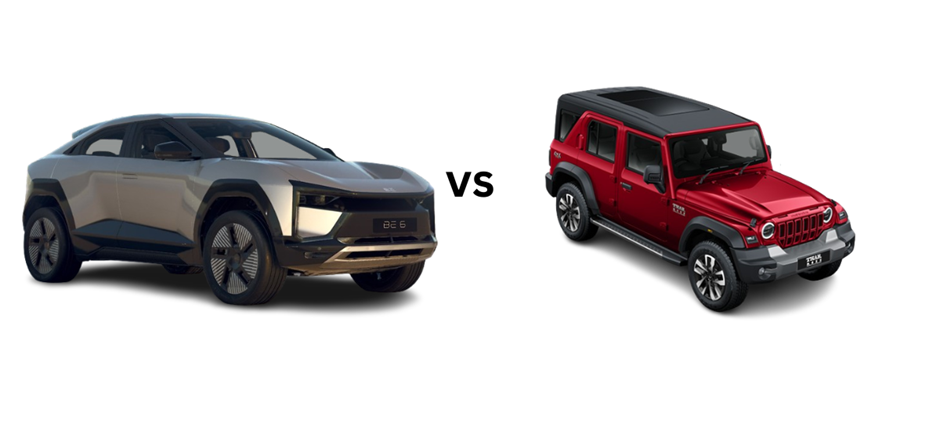
The automotive industry is currently defined by a fundamental tension between innovation and legacy. On one hand, there is a strong push towards electrification, digital integration, and software-driven experiences. On the other hand, traditional mechanical engineering and capability-focused design continue to hold significant appeal. The Mahindra BE 6 and Mahindra Thar Roxx embody this contrast, representing two distinct visions of what an SUV should be.
Rather than competing directly, they frame a broader debate about the future direction of mobility.
Innovation as a Forward-Looking Approach
The Mahindra BE 6 is a clear representation of innovation in the SUV space. Built on the INGLO electric-origin architecture, it integrates advanced components, including battery systems, suspension, and drivetrain, into a unified platform designed for efficiency and performance.
Its electric powertrain delivers:
- Up to 683 km range (MIDC-certified)
- High-performance output of up to 210 kW and 380 Nm torque
- Fast charging capability (20–80% in approximately 20 minutes)
Beyond performance, the BE 6 emphasises digital innovation. It features:
- AI-powered MAIA system with high computational capability (51 TOPS)
- Level 2+ ADAS with multiple sensors and radars
- Over-the-air updates for continuous improvement
This combination positions the BE 6 as a product designed to evolve over time.
Legacy as a Proven Foundation
In contrast, the Mahindra Thar Roxx represents the strength of legacy. Its design and engineering are built upon decades of off-road expertise, prioritising reliability and mechanical capability.
The vehicle is based on the M_GLYDE platform and is constructed from high-strength steel for durability and torsional rigidity.
Its capabilities include:
- 4XPLOR terrain modes for diverse surfaces
- Electronic locking differential for enhanced traction
- 650 mm water-wading depth for extreme conditions
These features are not experimental but proven, reflecting a design philosophy rooted in reliability and real-world performance.
Technology vs Mechanical Engagement
One of the key differences between innovation and legacy lies in how technology is integrated.
The BE 6 relies heavily on software and digital systems. Features such as:
- Augmented reality head-up display and dual-screen cockpit
- AI-driven interface for user interaction
- Connected ecosystem with multiple applications
create a highly digital driving environment.
The Thar Roxx, while incorporating modern technology such as ADAS Level 2 and connected-car features, maintains a focus on mechanical engagement. Its driving experience is shaped by:
- Physical terrain interaction
- Manual control systems
- Direct feedback from the vehicle
This difference highlights how innovation often prioritises automation, while legacy emphasises driver involvement.
Design Language: Future vs Heritage
The BE 6 adopts a futuristic design approach, characterised by:
- Aerodynamic surfaces
- Sleek, coupe-like profile
- Minimalist exterior elements
This design aligns with its electric and efficiency-focused identity.
The Thar Roxx, on the other hand, retains a heritage-inspired design, featuring:
- Upright stance and flat surfaces
- External hinges and exposed elements
- Tailgate-mounted spare wheel
These elements are not merely stylistic but functional, supporting off-road capability.
User Experience: Digital Comfort vs Physical Capability
The BE 6 offers a user experience centred on comfort and convenience. Its features include:
- Whisper-quiet cabin with advanced insulation
- Ambient lighting and immersive audio systems
- Smart connectivity and automation features
The Thar Roxx provides a different kind of experience. While it includes comfort features such as ventilated seats and premium interiors, its primary appeal lies in:
- Off-road exploration
- Adventure-focused driving
- Real-world capability
The contrast reflects two distinct interpretations of value.
Buyer Perspective: Future vs Familiar
The choice between innovation and legacy often depends on buyer priorities:
- Buyers choosing the BE 6 may prioritise sustainability, technology, and future readiness.
- Buyers choosing the Thar Roxx may value reliability, capability, and a connection to traditional SUV characteristics.
Both perspectives are valid, reflecting different expectations of a vehicle.
The Role of Digital Platforms
Online car-buying platforms such as ACKO Drive allow buyers to evaluate vehicles across multiple dimensions — technology, capability, efficiency, and usability before purchasing online.
In such comparisons, the BE 6 stands out for its innovation and forward-looking features, while the Thar Roxx stands out for its proven capability and rugged design.
This makes it easier for buyers to align their choice with their priorities.
Conclusion
The Mahindra BE 6 and Mahindra Thar Roxx represent two sides of the same debate — innovation and legacy. One looks toward the future with advanced technology and electric efficiency, while the other builds on a foundation of proven capability and mechanical strength.
As the SUV market continues to evolve, both approaches are likely to coexist, offering buyers the freedom to choose between progress and tradition.