The Maruti Suzuki Alto has an almost mythological place in Indian automotive culture. It is, statistically, the car that first taught a generation of middle-class Indians what it felt like to own and drive something of their own. It made new car ownership accessible when everything else seemed out of reach. That’s not a small thing. That’s actually everything.
The Alto K10, the peppier sibling to the standard Alto, returned in a new generation in 2022, redesigned, re-engineered, and substantially better than what came before. And while small cars have become a tougher sell in a market obsessed with ground clearance and SUV proportions, the Alto K10 makes the case that smart engineering still beats mere size, at least when the brief is accessibility and efficiency.
Start with the engine. The new Alto K10 uses the K10C 1.0-litre DualJet petrol motor, a twin-injector-per-cylinder unit that produces approximately 67 horsepower. That number, again, sounds modest, but context matters enormously here. The car weighs around 755 kilograms. That power-to-weight ratio gives the Alto K10 a lively, responsive character that larger, heavier budget cars simply cannot replicate despite their bigger engines. In city traffic, it feels genuinely nippy.
This generation also introduced an AMT, Automated Manual Transmission, option for the first time on the Alto K10, which is a bigger deal than it sounds. The older Alto was strictly manual-only, which was a genuine barrier for buyers in congested city conditions. Having an AMT now means the Alto K10 speaks to a much wider audience, including first-time drivers and older buyers who prefer single-pedal city driving.
The CNG variant deserves its own paragraph. With fuel prices doing what they’ve been doing, the factory-fitted CNG Alto K10 has become the de facto choice for buyers who clock high daily mileage, think cab operators, small business owners, and families running the car as a primary urban workhorse. The factory-fitted CNG retains the spare wheel, which is a thoughtful call Maruti made after years of aftermarket CNG installs compromising boot access.
Feature-wise, the new Alto K10 punches beyond expectations at its price. You get a digital instrument cluster, rear parking sensors, a dual-speaker music system in the mid-grade variants, and safety features including dual airbags and ABS as standard across the range, a notable improvement from the feature-sparse previous generation.
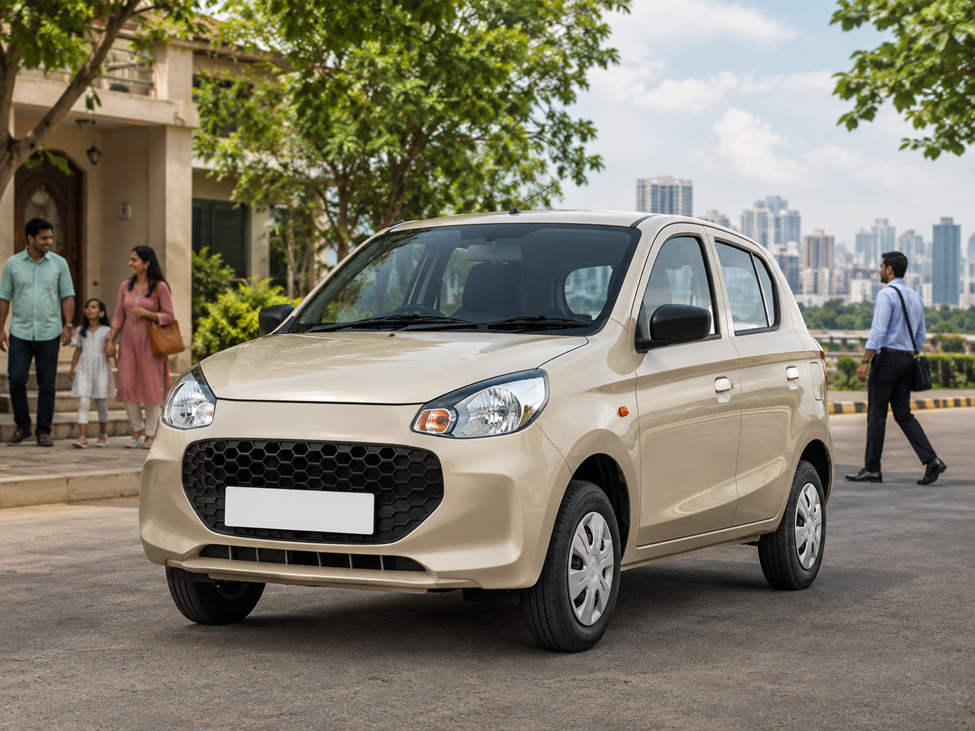
The exterior design has a more upright, squared-off look compared to the rounder older Alto. It’s not the most expressive car on the road, but it has a certain tidiness and compactness that makes parking in tight urban spaces genuinely easy. Turning radius is tight, visibility is excellent, and the raised ride height over its segment average means you’re not scraping on every speed breaker you encounter.
For prospective buyers researching the Alto K10 on-road price, the entry price currently sits around ₹3.5 lakh ex-showroom, making it among the most affordable new cars available in India today. The range tops out under ₹6 lakh, which means even the fully loaded variant is well within accessible territory. If you’re also exploring the broader Suzuki car price landscape, the Alto K10 sits at the entry point of a lineup that extends all the way to the Grand Vitara, offering genuine variety at every budget.
Ownership economics are straightforwardly compelling. Service costs are among the lowest of any new car in India. Spare parts are ubiquitous. And Maruti’s service network, with over 4, 000 touchpoints nationwide, means you’re never far from a workshop that can handle your car.
Critics of the Alto K10 will point to the NVH levels, noise, vibration, and harshness, which are not class-leading, especially at highway speeds. It also lacks the safety architecture of costlier cars. These are real limitations, and they deserve honest acknowledgement.
Colour and trim options on the new Alto K10 are notably more considered than before. Dual-tone exterior options, including a contrasting black roof in certain variants, give the car a younger, more contemporary look without changing its fundamental character. Maruti clearly understood that the audience for this car is not monolithic, there are buyers chasing absolute economy, and there are younger buyers who want something that doesn’t look like a base-trim appliance.
But the Alto K10 was never designed to be a highway cruiser or a premium safe room on wheels. It was designed to give someone who couldn’t previously own a car the dignity and utility of personal mobility. Judged by that brief, it continues to succeed in ways that matter.